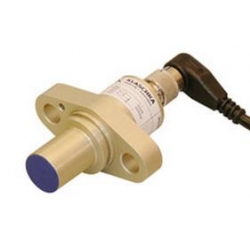
DOUBLE PULSE

DOUBLE PULSE

Products

[accordionmenu id="uniqued994e88" accordionmenu="6404"]

double-pulse

DOUBLE PULSE

Unlike inductive proximity switches pulse sensors are, due to their high geometrical resolving power, suitable for the detection of fine structures and motions. (Not suitable for axial approximation and non-magnetizable materials). Prefered tasks are the determination of rotational speed and direction of rotation of waves by gear wheels starting from module 0.3. Thus these sensors can be used particularly as incremental sensors, for counting tasks and for position control. With these sensors it is possible to detect racks or magnetic tapes in order to detect the speed and direction of linear motions.

  • high switching distances up to 25 kHz
  • static (standstill from 0 Hz) and dynamic operation
  • high resolution (< module 1)
  • robust housings
  • increased ambient temperature ranges from approx. -25 to + 120 °C

Description

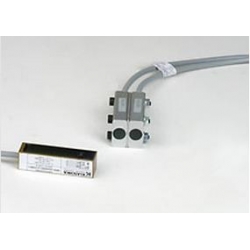
Hall element double switches are preferably used for the detection of positions and direction of motion of by-passing rack rails.

  • 2 outputs, RS-422
  • high switching frequency up to 15 kHz
  • static (standstill from 0 Hz) operation
  • double resolution
HEAT-RESISTANT

HEAT-RESISTANT

Products

[accordionmenu id="uniqued994e88" accordionmenu="6404"]

heat-resistant

HEAT-RESISTANT

Unlike inductive proximity switches pulse sensors are, due to their high geometrical resolving power, suitable for the detection of fine structures and motions. (Not suitable for axial approximation and non-magnetizable materials). Prefered tasks are the determination of rotational speed and direction of rotation of waves by gear wheels starting from module 0.3. Thus these sensors can be used particularly as incremental sensors, for counting tasks and for position control. With these sensors it is possible to detect racks or magnetic tapes in order to detect the speed and direction of linear motions.

  • high switching distances up to 25 kHz
  • static (standstill from 0 Hz) and dynamic operation
  • high resolution (< module 1)
  • robust housings
  • increased ambient temperature ranges from approx. -25 to + 120 °C

Description

Hall element switches for increased temperature ranges are also used in drives. They are preferably suitable for the detection of rotational speed and direction of rotation of waves by gear wheels starting from module 0.3. They can be used as incremental sensors, for counting tasks and for position control. They can also take up the speed and direction of linear movements by the detection of racks.

  • high switching frequencies up to 20 kHz
  • static (standstill from 0 Hz) and dynamic operation
  • high resolution (< module 1)
  • robust housing
  • increased ambient temperature ranges approx. -25 to + 100 °C
INDUCTIVE PULSE SENSORS

INDUCTIVE PULSE SENSORS

Products

[accordionmenu id="uniqued994e88" accordionmenu="6404"]

no-picture

INDUCTIVE PULSE SENSORS

Unlike inductive proximity switches pulse sensors are, due to their high geometrical resolving power, suitable for the detection of fine structures and motions. (Not suitable for axial approximation and non-magnetizable materials). Prefered tasks are the determination of rotational speed and direction of rotation of waves by gear wheels starting from module 0.3. Thus these sensors can be used particularly as incremental sensors, for counting tasks and for position control. With these sensors it is possible to detect racks or magnetic tapes in order to detect the speed and direction of linear motions.

  • high switching distances up to 25 kHz
  • static (standstill from 0 Hz) and dynamic operation
  • high resolution (< module 1)
  • robust housings
  • increased ambient temperature ranges from approx. -25 to + 120 °C

Description

All proximity switches of the type all metal standard can principally be employed as pulse sensors, as they have short response times and high switching frequencies up to 20kHz.
  • all metal with reduction factor 1 for all metals
  • switching distance from 1.5 up to 6mm
  • increased ambient temperature range -25 up to + 85 °C
  • increased max. operating frequency ≤ 20 kHz
  • magnetic field-resistant
INDUCTIVE SENSORS, DOUBLE PULSE

INDUCTIVE SENSORS, DOUBLE PULSE

Products

[accordionmenu id="uniqued994e88" accordionmenu="6404"]

inductive-sensors-double-pulse

INDUCTIVE SENSORS, DOUBLE PULSE

Unlike inductive proximity switches pulse sensors are, due to their high geometrical resolving power, suitable for the detection of fine structures and motions. (Not suitable for axial approximation and non-magnetizable materials). Prefered tasks are the determination of rotational speed and direction of rotation of waves by gear wheels starting from module 0.3. Thus these sensors can be used particularly as incremental sensors, for counting tasks and for position control. With these sensors it is possible to detect racks or magnetic tapes in order to detect the speed and direction of linear motions.

  • high switching distances up to 25 kHz
  • static (standstill from 0 Hz) and dynamic operation
  • high resolution (< module 1)
  • robust housings
  • increased ambient temperature ranges from approx. -25 to + 120 °C

Description

Inductive All Metall Proximity Double Switches are preferably used for the detection of positions and direction of motion of by-passing rack rails. (Recognition of forward-backward movement).

  • integrated detection for the direction of movement
  • all metal with reduction factor 1 for all metals
  • switching distance 1.2mm
  • increased ambient temperature range -25 up to + 85 °C
  • increased max. operating frequency ≤ 30 kHz
  • magnetic field-resistant
MAGNETIC FIELD

MAGNETIC FIELD

Products

[accordionmenu id="uniqued994e88" accordionmenu="6404"]
magnetic-field

MAGNETIC FIELD

Unlike inductive proximity switches pulse sensors are, due to their high geometrical resolving power, suitable for the detection of fine structures and motions. (Not suitable for axial approximation and non-magnetizable materials). Prefered tasks are the determination of rotational speed and direction of rotation of waves by gear wheels starting from module 0.3. Thus these sensors can be used particularly as incremental sensors, for counting tasks and for position control. With these sensors it is possible to detect racks or magnetic tapes in order to detect the speed and direction of linear motions.

  • high switching distances up to 25 kHz
  • static (standstill from 0 Hz) and dynamic operation
  • high resolution (< module 1)
  • robust housings
  • increased ambient temperature ranges from approx. -25 to + 120 °C

Description
Hall element switches are especially suitable for the detection of rotation speed and rotation direction of waves by means of gear wheels from module 0.7. They can be employed as incremental sensors, for counting tasks and for the position control. By sensing tooth racks they can detect the speed and direction of linear motions.

  • high switching frequencies up to 20 kHz
  • static (standstill from 0 Hz) and dynamic operation (from 1 and/or 5 Hz)
  • high resolution (< module 1)
  • robust housing
  • ambient temperature ranges approx. -25 bis + 80 °C
ALL METAL AUTOMOTIVE

ALL METAL AUTOMOTIVE

Products

[accordionmenu id="uniqued994e88" accordionmenu="6404"]

all-metal-automotive

ALL METAL AUTOMOTIVE

NON-FERROUS METAL

Inductive proximity switches for machines and plants are non-contact- and contactless operating sensors for the movement of drives and mechanical components, which are not subject to mechanical wear. They are mainly used as limit switches, but due to their robustness (completely moulded) and their high switching frequency they can also be used for many other tasks, for example as pulse sensors for the rotational speed detection.

They are preferably used where high switching frequencies and operating speeds, switching point precision and reliability, operation under less favourable conditions (e. g. under water) and high durability are required.

Klaschka launched the first inductive proximity switch already in 1964. Today the sensor range includes more than 1,500 different types. The types specified here represent a selection and are usually available from stock. In addition we offer a large number of standard- and customer-specific executions, whose technical data we gladly send our customers on demand.

  • sturdy
  • high switching frequencies
  • high load currents
  • safe against short-circuits, interference voltages, confounding of terminals

Description

There are special requirements for inductive proximity switches used in welding plants (e. g. in body shops in the automotive production) due to strong magnetic fields, welding splashes and the use of different metals, such as iron, aluminium, copper, brass and V2A.

Convenentional proximity switches have deviating switching distances (reduction factors) and are sensitive against these disturbing conditions.

Klaschka all metal switches of the Automotive Series have the same switching distance for all metals (reduction factor 1). Further special characteristics are: Increased switching distances, increased ambient temperature ranges, increased switching frequencies as well as magnetic field- and wel-resistance due to Teflon-coating.

  • all metal with reduction factor 1 for all metals
  • increased switching distance
  • increased ambient temperature range -25 to + 85 °C
  • increased max. operating frequency ≤ 20 kHz
  • magnetic field-resistant
  • weld-resistant due to Teflon-coating